Grub Control 101: Stopping the Hidden Pest That Wrecks Lawns in Late Summer
By the time you see grub damage, the best time to prevent it has already passed. Grubs — the larvae of beetles like Japanese beetles and June bugs — quietly chew through your grass roots all summer, leaving brown patches that peel up like loose carpet in August. Here's how to tell if you have them, when to treat (hint: now), and the one step almost everyone forgets.
Grub Control 101: Stopping the Hidden Pest That Wrecks Lawns in Late Summer
Published on LawnMaps.com | Estimated read time: 5 minutes
You've watered all summer. You've mowed at the right height. And then one morning in August you walk out to find brown patches that peel up like a loose rug — and maybe a few holes where something has been digging overnight. That's not drought. That's grubs.
Here's the frustrating part: by the time you see grub damage, the best moment to prevent it has already passed. The work happens now, in early summer, before there's a single brown patch to point at. So if you do one proactive thing for your lawn this month, this is a strong candidate.
Let's break down what grubs are, how to tell if you have them, and exactly what to do — including the honest answer to "do I even need to treat?"
What Are Grubs, Exactly?
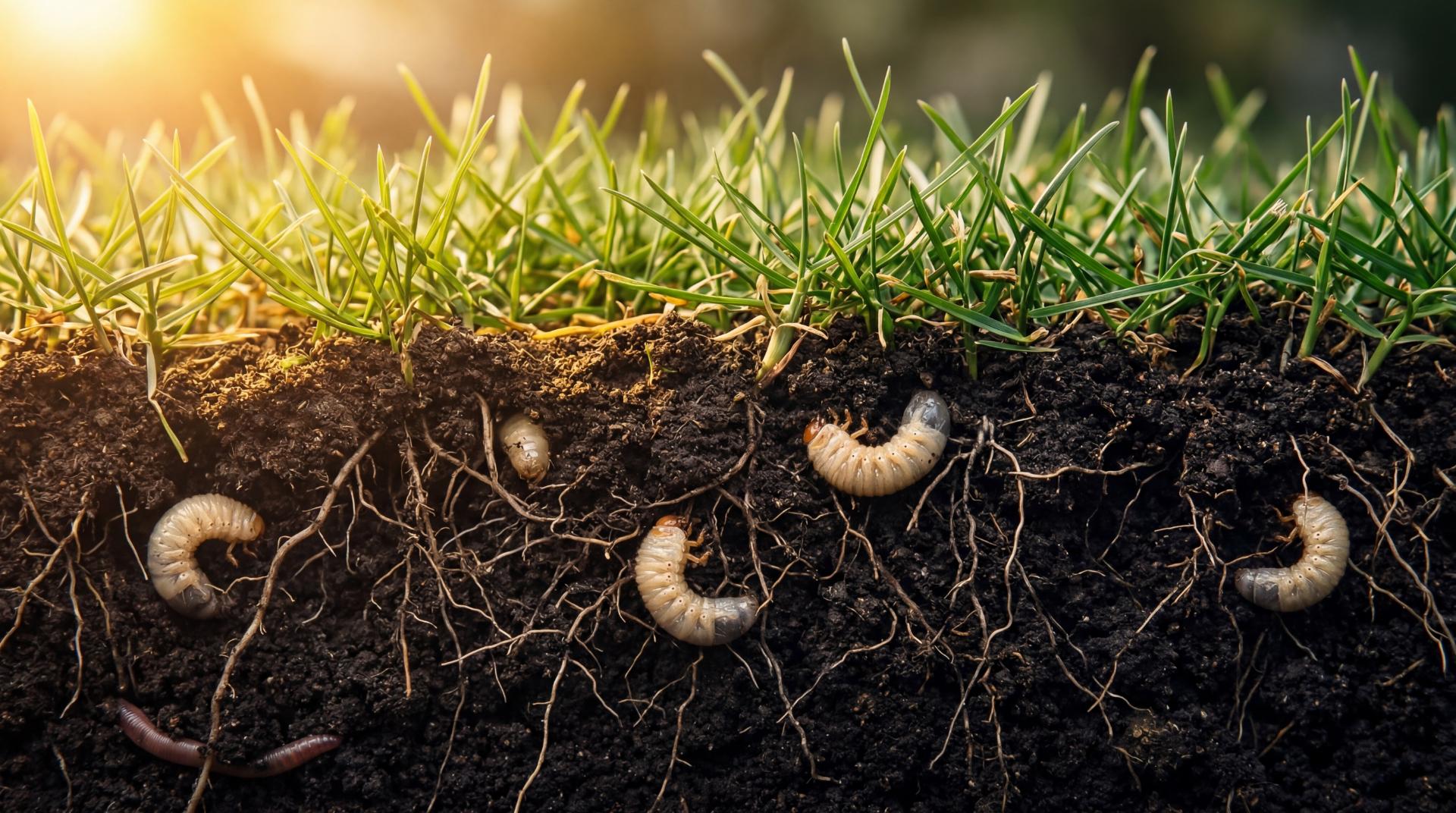
Grubs (sometimes called white grubs) are the larval stage — the baby stage — of beetles like Japanese beetles, June beetles (the "June bugs" that bonk into your porch light), and chafers. They're small, cream-colored, soft-bodied, and curl into a distinctive C-shape when you dig them up.
They live a couple inches down in the soil, and they eat one thing: your grass roots. A lawn with chewed-off roots can't pull up water, so it browns out and dies in patches — even if you're watering perfectly.
Why Timing Is Everything
Grubs run on a yearly clock, and understanding it is the whole game:
| Time of Year | What's Happening | What You Do |
|---|---|---|
| Early–mid summer (now) | Adult beetles emerge, mate, and lay eggs in the soil | Apply preventive control |
| Late summer (Aug–Sept) | Eggs hatch; young grubs feed hard on roots | Damage appears; curative control if needed |
| Fall | Grubs keep feeding, then burrow deep as soil cools | Watch for late damage |
| Spring | Grubs feed briefly, then turn into beetles | Cycle repeats |
See the problem? The damage shows up in late summer and fall, but the easiest, most reliable time to stop it is right now — before the eggs even hatch. Preventive products need to already be in the soil, waiting, when those young grubs show up hungry.
That's why this is a "get it done by mid-July" job, not a "deal with it when I see brown spots" job.
Do You Actually Have a Grub Problem?
Be honest with yourself here, because not every lawn needs grub treatment every year. A healthy lawn can shrug off a small number of grubs without you ever noticing. Treating a lawn that doesn't need it is wasted money and product.
Watch for these signs:
- Animals digging up your lawn. Skunks, raccoons, and birds dig for grubs like they're trail mix. Surprise overnight holes are often the first clue, before the grass even browns.
- Brown patches that don't respond to water. Drought-stressed grass perks back up when you water it. Grub-damaged grass doesn't, because the roots are gone.
- Turf that pulls up like loose carpet. This is the classic test. Grab a brown patch and tug. If it rolls back like a piece of sod with no roots holding it down, grubs are the likely culprit.
- Lots of beetles around in early summer. Not proof of grubs, but a heads-up that egg-laying season is underway.
The Cut Test (one square foot, two minutes)
Want to know for sure? Use a spade to cut three sides of a one-square-foot flap of turf about 2–3 inches deep, peel it back like a book cover, and count the grubs in the soil underneath.
Here's the rule of thumb most lawn experts use: fewer than about 5 grubs per square foot, and a healthy lawn usually handles it on its own. Once you're seeing more than 5–10 per square foot, that's when treatment is worth it. Flip the flap back down, stomp it in, water it, and you're done.
Preventive vs. Curative: Knowing the Difference
There are two completely different jobs here, and they use different products at different times. Mixing them up is the most common grub-control mistake.
Preventive control is what you apply now (roughly June through mid-July). It puts a long-lasting ingredient in the soil so that when grubs hatch and start feeding, they're stopped early. It's the gentler, more reliable, more forgiving approach — and the right call for most homeowners.
Curative control is the emergency option for when you've already got active, feeding grubs in late summer or fall. These products are faster and harsher, must be watered in heavily, and work best on small grubs (big, mature grubs are tougher to kill). This is your "I missed the window" fallback.
Here's a quick cheat sheet of common active ingredients — the actual chemical name listed on the bag, which matters more than the brand:
| Type | Common Active Ingredient | Notes |
|---|---|---|
| Preventive | Chlorantraniliprole (e.g., Scotts GrubEx) | Lower toxicity, long-lasting, gentle on pollinators when used right. Apply earlier in the window. |
| Preventive | Imidacloprid | Effective, but it's a neonicotinoid — see the bee note below. |
| Curative | Trichlorfon | Fast-acting rescue treatment for active grubs. |
| Curative | Carbaryl | Another curative option; water in well. |
A quick note on bees: imidacloprid is a neonicotinoid, a class of insecticide that can harm pollinators. If you use it, never apply it over flowering weeds — mow off any dandelion or clover blooms first so bees aren't drawn into the treated area. If that's a concern for you, chlorantraniliprole (GrubEx) is the more pollinator-friendly choice.
The One Step Everyone Skips: Watering It In
Grub products are almost always sold as granules — little pellets you spread across the lawn. But a granule sitting on top of a grass blade does absolutely nothing. The active ingredient has to get down into the soil where the grubs live.
That means you need to water it in — about half an inch of water within 24 hours of applying. If you skip this, you've essentially spread expensive sand on your lawn. (Not sure how to measure half an inch of water? Our guide to watering your lawn the right way walks through the tuna-can trick that makes it easy.)
Grub products are also applied by the 1,000 square feet, so you need to know your lawn's size to buy the right amount and apply the right rate — too little won't work, and too much is wasted money. Map your lawn for free at LawnMaps.com and you'll have your exact square footage in a few minutes, broken down by zone.
What About Natural Options?
If you'd rather skip the chemicals, there are a couple of organic-leaning options — but I'll be straight with you about their limits:
- Milky spore is a naturally occurring bacterium that targets Japanese beetle grubs. The catch: it only works on that one species (not chafers), and it can take a few years to establish in your soil. Slow and inconsistent.
- Beneficial nematodes are microscopic worms that hunt grubs. They can genuinely work, but they're live organisms — you have to apply them fresh, at the right time, into moist soil, and keep things damp. More finicky than most beginners want to deal with.
And the quietest grub defense of all? A healthy, deep-rooted lawn. Grass with a strong root system tolerates grub feeding far better than weak, shallow-rooted turf. Smart mowing and proper watering all season long are part of your grub strategy, even if it never says "grub" on the label.
Your Grub Control Game Plan
Here's the whole thing in five steps:
- Decide if you need to treat. Past grub damage? Lots of beetles? Animals digging? Do the cut test. No history and no signs — you may be able to skip it this year.
- If you're treating preventively, do it now — June through mid-July — with a chlorantraniliprole product (like GrubEx) for the safest, most reliable results.
- Know your square footage so you apply the correct rate.
- Water it in with about half an inch of water within 24 hours.
- Stay alert in late summer. If brown patches show up and the turf lifts like carpet, switch to a curative treatment for the grubs already feeding.
Grub control is one of those quiet, unglamorous jobs that nobody notices when you do it right — because the reward is a lawn that doesn't fall apart in August while the neighbors are scratching their heads. A few minutes now buys you a green September.
When you're ready, map your lawn for free at LawnMaps.com to get the exact square footage you'll need to buy and apply grub control the right way — and to keep the rest of your seasonal plan on track.