Why Your Lawn Turns Brown Along the Road First (And How to Prevent It)
Brown strips along the road and driveway are the first sign of drought stress in any lawn. Here's why pavement edges burn out first — and how soil moisture managers, smarter watering, and a few simple habits keep them green all summer.
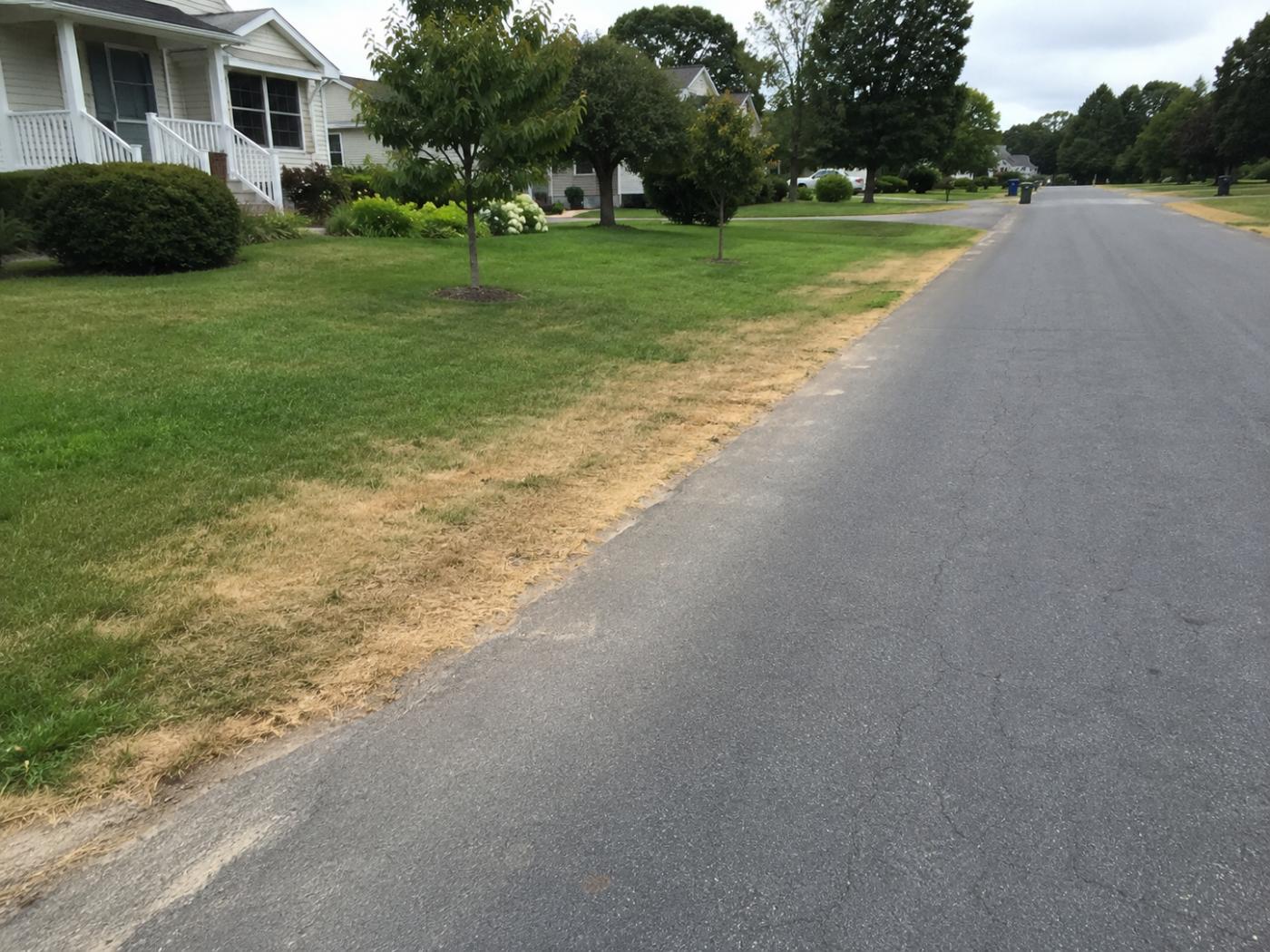
If your lawn is starting to brown out, odds are it didn't happen everywhere at once. It started as a strip — right along the road, the driveway, or the sidewalk. That's not a coincidence, and it's not bad luck. The edges of your lawn live in the harshest microclimate on your property, and during a drought they're always the first to go.
The good news: once you understand why it happens, it's one of the most preventable problems in lawn care.
Why the Edges Burn Out First
A few things gang up on the grass next to pavement:
Pavement is a radiator. On a 90°F day, asphalt can hit 140°F or more. All that heat radiates sideways into the first few feet of your lawn, baking the soil from the edge in. Your grass isn't just dealing with air temperature — it's standing next to a griddle.
The soil is shallower than you think. Roads and driveways sit on a bed of compacted gravel and road base that usually extends past the visible pavement. The strip of lawn along the edge often has just a few inches of real soil over that base layer. Less soil means less water storage and shallower roots.
Dry soil starts repelling water. When soil along an edge dries out completely, it can become hydrophobic — water beads up and runs off instead of soaking in. At that point, even when your sprinklers run (or it finally rains), the water never reaches the roots. The dry spot feeds itself.
Sprinkler coverage is weakest at the perimeter. Irrigation systems are designed for head-to-head coverage in the middle of zones. At the edges, coverage gets thin — and the edge along the road is exactly where the lawn needs water most.
Stack all four together and you get the classic drought signature: a crispy brown ribbon tracing the pavement while the middle of the lawn still looks fine.
How to Tell It's Drought (Not Something Else)
Before treating, confirm the diagnosis. Push a screwdriver into the brown strip, then into healthy turf nearby. If the screwdriver fights you in the brown area but slides into the green area, you've got a moisture problem. (If the soil is moist and the grass is still browning, look at disease or grubs instead.)
Also check whether the grass is dormant or dead: tug on it. Firmly rooted brown grass with a hint of green at the crown is dormant and will bounce back. Grass that pulls up with no resistance is gone, and that strip will need overseeding in early fall.
Prevention: Keep the Edges Green All Summer
1. Use a soil moisture manager
This is the single best tool for the job. Soil moisture managers (Hydretain is the best-known) are hygroscopic humectants — they attract water vapor from the air within the soil and condense it back into droplets your roots can actually use. They don't add water; they make the water already in your soil last dramatically longer.
For edge strips specifically, this is a perfect match, because the problem is soil that can't hold moisture next to a heat source. A moisture manager typically stretches the time between waterings by 30–50% and keeps shallow-soil areas from hitting the wilting point between irrigation cycles.
Application tips:
- Apply before stress sets in, ideally late spring — but mid-drought still helps the areas that are dormant, not dead.
- Water it in immediately and deeply. It only works once it reaches the root zone.
- Reapply roughly every 3 months during the growing season — it's biodegradable and breaks down over time.
- Granular and hose-end liquid versions both work; the liquid is easy to concentrate along edges where you need it most.
2. Break the hydrophobic crust
If water is beading off the dry strip, hand-water it slowly in a few short passes (let each pass soak before the next), or apply a wetting agent. Once water penetrates again, your normal irrigation — and your moisture manager — can actually do their jobs.
3. Water deeply, not frequently
Daily shallow watering keeps roots near the surface, which is exactly where they cook along pavement. Aim for deep, infrequent watering — about 1 to 1.5 inches per week including rain — to push roots down where the soil stays cooler and wetter. If you run a smart controller, let it stretch intervals; that's the whole point.
4. Audit your sprinkler coverage at the edges
Set tuna cans or measuring cups along the road strip and run your zones. You'll often find the edge gets half the water the middle does. Adjust head arcs, add a head, or plan to hand-water that strip during heat waves. If you've mapped your sprinkler heads in LawnMaps, the coverage circles make these perimeter gaps obvious before the grass tells you about them.
5. Mow taller — especially in summer
Taller grass shades the soil, cuts surface evaporation, and grows deeper roots. For cool-season lawns, raise the deck to 3.5–4 inches in summer. The first foot of lawn along the pavement benefits more from this than anywhere else on the property. And never mow a drought-stressed lawn during the heat of the day — if it doesn't spring back when you step on it, skip the mow.
6. Build the soil over time
The long-game fix is more organic matter: topdress thin edge strips with compost in spring or fall, and aerate compacted edges. Every bit of organic matter increases the soil's water-holding capacity — which means the edge takes longer to dry out and recovers faster when rain returns.
If the Strip Is Already Dead
Don't fight it in summer. Keep the area watered enough to keep weeds from filling in, then overseed in late August or September when soil temps drop and recovery conditions are ideal. Work some compost into the strip before seeding, and apply a moisture manager at seeding time — it's excellent for keeping seedbeds consistently moist.
The Takeaway
Brown edges along the road are an early-warning system: they show you where your lawn's water reserves run out first. Treat the strip — moisture manager, deep watering, taller mowing — and you're not just fixing a cosmetic problem, you're drought-proofing the most vulnerable part of your lawn before the rest of it follows.