PSA: Your Mower Is Lying to You About Cut Height
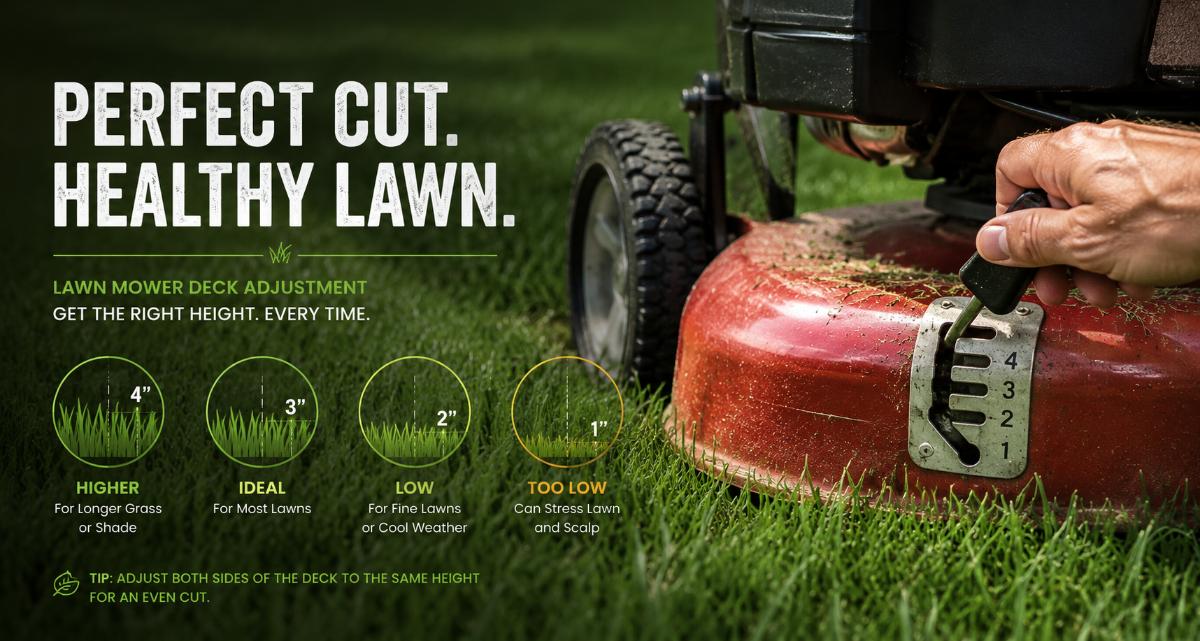
The number on your mower's height dial is not your actual cut height. A "4" might be cutting at 2.5 inches — and that's a summer-stress sentence for your lawn. Here's the five-minute check every homeowner should do before the heat hits.
PSA: Your Mower Is Lying to You About Cut Height
Published on LawnMaps.com | Estimated read time: 6 minutes
Quick public service announcement before summer hits: the number on your mower's height adjustment is not the height of your cut. Not even close, in a lot of cases.
I had this exact conversation with my neighbor last weekend. Summer's right around the corner, her lawn was already looking stressed, and I told her she needed to be mowing higher. Her response: "I can't — I'm already on the highest setting."
So I asked her if she'd ever actually measured what her highest setting was cutting at. She hadn't. We checked. Her "highest setting" — the number 4 on her dial — was cutting her grass at 2.5 inches.
That's not a high mow. That's a summer-stress sentence.
If you've never measured what your mower is actually doing, this article is for you. It takes about five minutes and could save your lawn this summer.
Why Summer = Higher Mowing
Before we get into the measuring part, let's quickly cover why this matters so much right now.
When the weather gets hot, taller grass does four critical things for your lawn:
- Shades the soil — keeps soil temperatures lower, which means less moisture evaporation and less root stress.
- Drives deeper roots — there's a rough 3-to-1 ratio between leaf height and root depth. Taller grass = deeper roots = better drought tolerance.
- Shades out weed seeds — crabgrass and many summer weeds need direct sunlight on the soil to germinate. Tall grass blocks that light.
- Reduces water needs — a lawn cut at 4 inches uses noticeably less water than the same lawn cut at 2 inches.
A lawn mowed short in July is a lawn that's brown by August. Not because it's getting bad weather — because it's been set up to fail.
Target Cut Heights for Summer
Here's what you actually want to be cutting at as we head into the hot months:
| Grass Type | Spring/Fall | Summer (Hot Stretch) |
|---|---|---|
| Kentucky Bluegrass | 2.5–3 inches | 3.5–4 inches |
| Tall Fescue | 3–3.5 inches | 4–4.5 inches |
| Perennial Ryegrass | 2.5–3 inches | 3.5–4 inches |
| Fine Fescue | 2.5–3 inches | 3.5–4 inches |
| Bermuda | 0.5–1.5 inches | 1.5–2.5 inches |
| Zoysia | 1–2 inches | 2–2.5 inches |
If you don't know your grass type, that's a whole other article (coming soon). For now, if you live in the northern half of the U.S., you're almost certainly dealing with a cool-season grass and you should be aiming for 3.5–4 inches.
But here's the catch — that number means nothing unless you know what your mower is actually cutting at.
The Factory Setting Trap
Every mower manufacturer uses different settings. A "4" on one brand might be 3 inches. A "4" on another might be 4.5 inches. A "4" on a worn-out deck that's never been leveled might be 2.5 inches.
There are three reasons your mower's settings can't be trusted:
-
Manufacturer numbering is arbitrary. The numbers 1 through 7 (or A through F, or whatever your mower uses) are just positions — not measurements. They're not standardized across brands or even across models from the same brand.
-
Decks come out of the factory unleveled. This one shocks people. Brand-new mowers often have a deck that sits slightly tilted side-to-side or front-to-back. If nobody levels it before the first mow, every cut you make for the life of that mower will be off.
-
Decks go out of level over time. Hitting roots, curbs, sticks, or uneven ground gradually knocks the deck out of alignment. Even normal wear on the height-adjustment linkages can shift things.
The cumulative effect? A setting that says "4" can deliver anywhere from 2 inches to 4.5 inches depending on your specific mower, its age, and whether anyone's ever checked it.
How to Check What You're Actually Cutting At
There are two ways to do this, and you can do either one in under ten minutes.
Method 1: Tape Measure (Free)
This is the simplest test and the one I'd suggest doing first:
- Mow a small section of lawn as you normally would. Don't change any settings.
- Walk out to that section right after. Find a spot where the grass looks evenly cut.
- Press a tape measure straight down to the soil (not through the grass, but next to it — push the tape past the blades).
- Read the height of the cut grass at the tip — that's your actual cut height.
Repeat in a couple of spots, especially front and back of the lawn, in case your deck is tilted. If you get different numbers in different areas, your deck is out of level.
Method 2: Deck Leveling Gauge ($10–15)
A deck leveling gauge is a small plastic tool you slide under the deck while the mower is on a flat surface. It tells you the height of the blade tip from the ground in inches. You can find them on Amazon — search for "lawn mower deck leveling gauge" — they're around ten bucks.
The advantage of the gauge over a tape measure:
- You can check before mowing instead of after.
- You can measure all four corners of the deck to see if it's level.
- You can adjust and re-check in real time.
If you're going to level your deck (which you should), the gauge is worth the small investment.
Why Leveling Your Deck Matters
If you measure two different corners of your deck and they're more than about 1/8 of an inch apart, your deck is out of level and your lawn is paying for it.
An unlevel deck creates:
- Uneven cuts — strips of taller and shorter grass.
- Scalping on one side — usually the low side digs in on turns or slopes.
- A washboard look — alternating short and tall stripes that show up especially in low light.
- Stressed grass on the scalped side during summer heat.
Leveling is usually done with simple hand tools — most decks have adjustment nuts or bolts on the deck linkages. Your owner's manual will show the exact spots. The process is:
- Park the mower on a flat surface (a garage floor or driveway works).
- Set the deck to your normal cut height.
- Measure the blade tip height at all four corners.
- Adjust the linkages until all four corners are within 1/8 inch of each other.
- Front-to-back, the front of the deck should sit slightly lower than the back — about 1/8 to 1/4 inch — so the front blade tip catches the grass first. This is called "deck rake" or "pitch."
That's it. It's a 20-minute job, and most homeowners never do it.
Your Action Plan This Weekend
Before your next mow, here's what to actually do:
- Measure your current cut height with a tape measure on a section you mowed recently.
- Compare it to the summer target for your grass type (see the table above).
- If it's too low, raise the deck setting and remeasure after your next mow.
- If raising the setting doesn't get you high enough, your deck is probably not leveled correctly — adjust the linkages and remeasure.
- Pair this with the right mowing technique — full throttle, slower ground speed for the longer grass. (We covered that in the Mower Speed & Throttle article.)
One Last Note: The One-Third Rule Still Applies
If you've been mowing at 2.5 inches all spring and you jump straight to 4 inches, you're going to need to ease into it. The one-third rule (covered in our Spring Mowing Guide) says never remove more than a third of the blade in a single cut.
So if your grass is currently 3.5 inches tall, cut to 2.5. Then let it grow back. Cut to 3 next time. Then 3.5. Then 4. Step it up over a few mowings rather than shocking the lawn with a sudden change.
Summer's coming fast. Five minutes with a tape measure could be the difference between a green lawn in August and a stressed-out brown one. Go check your deck.
Want to track your lawn's seasonal plan in one place? Map your lawn for free at LawnMaps.com — you can save your mowing heights by season, set reminders for deck checks, and build a custom care plan for your grass type and climate zone.